Software Subscription Audit: Cut Costs Without Breaking the Business
Unused seats and forgotten renewals are only half the problem. Build a subscription register that connects each tool to its owner, purpose and next cash payment.

A software bill can be small enough to escape attention and still arrive every month for years. Multiply that by unused seats, overlapping tools and annual renewals, and the business can lose track of what it has committed to.
A useful software subscription audit answers three questions: what are we paying for, what would break if we changed it, and when would the saving actually reach the bank?
The aim is not to cut every subscription. It is to keep the tools that earn their place, retire the ones that do not, and put renewal decisions ahead of payment dates.
Start with a subscription register, not a cancellation list
Pull the last twelve months of software transactions from your accounting records, card statements and supplier invoices. A monthly-only review can miss annual renewals. Check payments made by different entities or cards, but keep each legal customer and its commitments separate.
For every service, record:
- Supplier, product and account: distinguish two legitimate subscriptions from an accidental duplicate.
- Business owner: the person who can explain the workflow and approve a change.
- Cost and billing basis: currency, tax shown on the invoice, monthly or annual commitment, seat count and usage charges.
- Next payment and notice date: a renewal date is not necessarily the last day you can cancel.
- Users and dependencies: who uses it, what data it holds and which systems depend on it.
- Decision and evidence: retain, reduce, replace or investigate, with a named action owner and due date.
Keep payment information in the accounting or payment system. The register needs a way to identify the account, not full card details, passwords or API keys.
Review use before removing seats
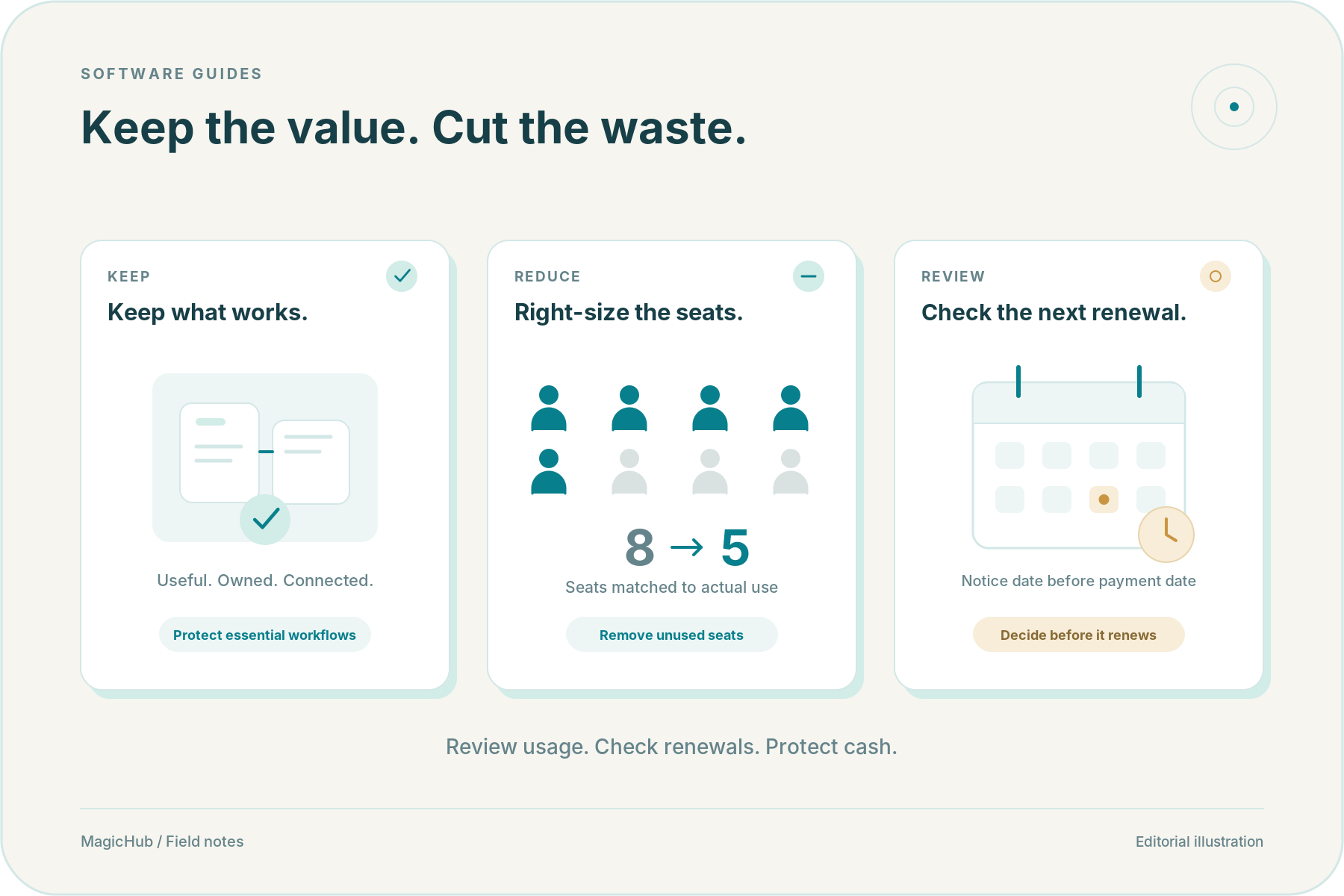
Ask the owner to show a recent business output: an invoice run, a customer handover, a completed project or a report somebody uses. A login count is useful evidence, but it is not a verdict. A backup service or compliance archive may be valuable precisely because staff rarely open it.
Separate unused seats from unused products. Reducing a plan from eight users to five may be less disruptive than replacing the whole system. Conversely, five people opening an app does not prove that it creates value if the same work is repeated elsewhere.
Australian Government guidance on digital tools recommends reviewing existing tools and duplication, assessing total ownership cost and monitoring whether tools continue to help. Use that as a starting principle, then test the actual workflow in your business.
Calculate savings on the right date
Keep three numbers separate: the ongoing cost reduction, the cash saving over your chosen planning period, and any one-off cost of making the change.
Fictional example: an Australian service business reviews its subscriptions on 6 October. All amounts below are AUD cash payments on a consistent, simplified basis. Taxes, exchange-rate movements and implementation costs are excluded from this example.
| Subscription | Decision | Cash effect |
|---|---|---|
| Project tool: eight seats at A$30 a month | Reduce to five seats, with supplier confirmation that the lower bill starts on 1 November | A$90 less per month from November; A$180 saved across November and December |
| Overlapping reporting tool: A$120 a month | Cancel after checking the replacement workflow; no further charges from 1 November | A$120 less per month from November; A$240 saved across November and December |
| Unused annual tool: A$2,400 renewal on 15 January | Give notice within the contract window and confirm non-renewal; current term is non-refundable | No October–December refund; A$2,400 renewal payment avoided in January |
The first two decisions reduce recurring monthly payments by A$210. They save A$420 across November and December, not A$2,520 immediately. The annual decision avoids a later payment; it does not put the previous renewal back in the bank.
Only move a saving from “proposed” to “confirmed” when the effective date and charges are clear. If a replacement needs A$600 of setup work, include that outflow on its expected payment date rather than hiding it inside an annual savings headline.
Put the dated changes into your 13-week cash flow forecast. Keep the accounting expense treatment separate from payment timing, and ask your accountant how any prepayment or tax treatment applies.
Treat annual discounts and foreign currency carefully
An annual plan can have a lower total price but require more cash upfront. Compare the next twelve months of actual payments under each option, including the possibility that headcount or requirements change. A discount is not automatically worth losing the ability to scale down.
For USD or other foreign-currency subscriptions, record the supplier's currency and use the actual AUD settlement for historical spending. For future renewals, label the assumed exchange rate and any known fees. Do not treat last month's conversion as a guaranteed future price.
Use the invoice to establish tax charged. Do not assume every overseas subscription includes Australian GST or convert an uncertain tax treatment into a confident saving.
Cancel safely: billing and access are different jobs
October 2026 is Cyber Security Action Month, a useful prompt to review access alongside spending. A lower seat bill does not, by itself, prove that an old account has lost access.
Before retiring a tool, have its owner check data exports, integrations, automated jobs and recovery arrangements. Confirm who will maintain the replacement. Test a real workflow before closing the original service, and preserve records that the business needs to retain.
Review former staff and contractor access separately. The ATO's small-business cybersecurity guidance includes removing access for people who no longer need it. Your IT owner should handle account and integration changes with the appropriate approvals.
Finally, save the supplier's cancellation or plan-change confirmation and check the next bill. Stopping use, cancelling a direct debit and ending a contract are not interchangeable steps; verify the supplier's terms and the agreed outcome.
Make the review repeatable
Bring a short exception list to the monthly business review: renewals approaching their notice deadlines, ownerless subscriptions, unexplained usage increases and promised savings that have not appeared.
Set review reminders far enough before each notice deadline for the owner to assess alternatives and migrate if necessary. The right lead time depends on the contract and how critical the system is.
The useful outcome is a decision trail: this tool supports this work, this person owns it, and this payment belongs in this period. That connects everyday operating choices to the financial plan without assuming that fewer apps always means a better business.
When evaluating MagicHub or any other platform, ask to see the workflows you need in the current release. Treat consolidation as a business case to test, including migration effort and operational risk, rather than a savings promise.
Sources checked 6 October 2026. General business education only, not accounting, tax, legal or financial advice. The worked example is fictional and is not a customer result or industry benchmark.
Good thinking deserves
a connected workspace.
Bring your plans, numbers and customer workflows together.
Start free with MagicHub