
Inventory Cash Flow: Can You Afford the Next Stock Order?
A stock order can improve future sales while squeezing cash before the first item sells. Test the payment dates, demand assumptions and lowest forecast balance before committing.

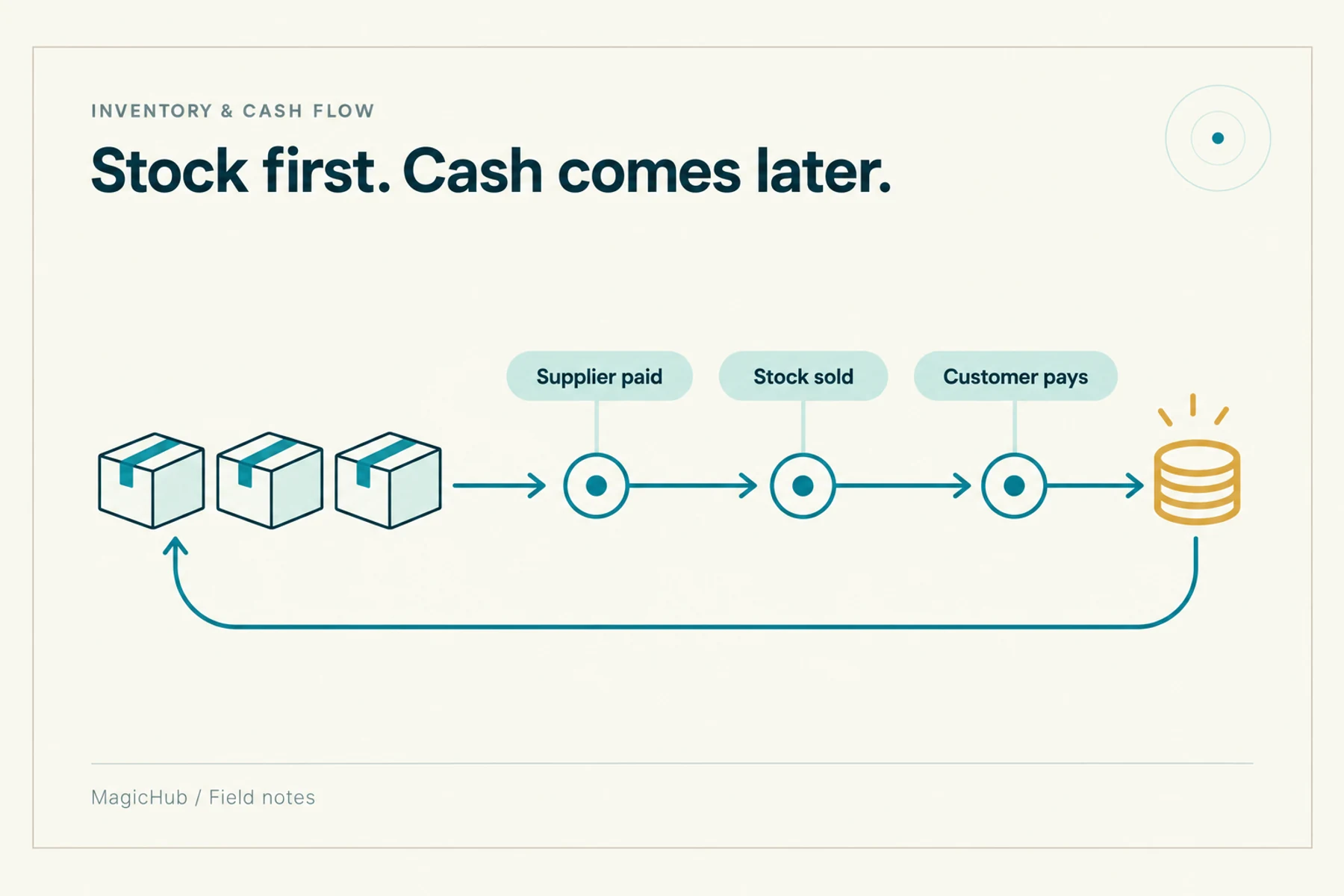
A supplier offers a better unit price if you buy more. The products sold well last season, and the sales forecast makes the order look sensible. The difficult part may arrive before a single customer pays: the deposit, final supplier payment and freight bill land close together.
To test whether you can afford a stock order, add its dated payments and expected customer receipts to your existing cash forecast. Then check the lowest balance, including a slower-sales case, against the cash your business needs to keep operating.
This inventory cash-flow check is useful for Australian retailers, wholesalers and other stock-holding businesses. If you buy ahead of Christmas or summer trading, run it before committing to the order, while you can still change the quantity or delivery plan.
Start with the stock you actually need
Check sellable units on hand, stock already allocated to customers and confirmed orders still in transit. A reorder based only on last year's purchase quantity can overlook unsold stock or an inbound delivery.
Build the demand assumption at product level. Record expected weekly sales, the evidence behind them and the date the new stock must be available. Separate confirmed customer orders from a sales target or promotion forecast. Allow for supplier lead time and the risk of running out of essential lines.
business.gov.au's inventory guidance recommends using sales patterns, delivery lead times, seasonal demand and supplier reliability when setting reorder points. Use those inputs to explain the quantity you are proposing, then test its cash effect.
Put the whole order on a payment calendar
The supplier's unit price is one part of the commitment. Business Queensland's stock-control guidance also identifies freight, storage, insurance, financing and spoilage costs.
For your proposed order, record:
- Order payments: deposit, balance, currency, due dates and any conditions that trigger payment.
- Arrival costs: freight, handling and any applicable import charges, using quotes or clearly labelled estimates.
- Extra operating payments: additional storage, packing, staffing or marketing needed for this stock.
- Customer cash: expected settlement dates after delivery, payment terms, payment-provider delays, refunds and fees.
Keep these movements separate from the accounting margin. Buying inventory can reduce cash before the related cost appears against sales in the profit report. MagicHub's guide to profit versus cash flow explains that distinction.
Choose and label a consistent GST treatment. A forecast of bank movements normally needs the amounts actually paid or received, with relevant BAS payments or refunds on their own dates. Ask your accountant to check the treatment where necessary.
Worked example: a good selling opportunity with a cash squeeze
Fictional example: a small Australian retailer is considering 600 units at A$50 each. The supplier requires a 30% deposit in week one and the remaining A$21,000 in week three. Freight of A$2,400 is also payable in week three.
The retailer expects customer receipts of A$12,000 in week four, A$18,000 in week five and A$18,000 in week six. These receipts relate only to the proposed order. Its existing forecast already includes the rest of the business, and excludes both this order's payments and its receipts.
All amounts below are AUD. GST, tax settlements, finance charges, refunds and selling fees are excluded to isolate the timing effect. Add those items before using this approach for a real decision.
| Week | Base closing cash without order | Order payments in week | Order receipts in week | Closing cash with order |
|---|---|---|---|---|
| 1 | A$50,000 | A$9,000 | A$0 | A$41,000 |
| 2 | A$47,000 | A$0 | A$0 | A$38,000 |
| 3 | A$44,000 | A$23,400 | A$0 | A$11,600 |
| 4 | A$42,000 | A$0 | A$12,000 | A$21,600 |
| 5 | A$40,000 | A$0 | A$18,000 | A$37,600 |
| 6 | A$39,000 | A$0 | A$18,000 | A$54,600 |
Each adjusted closing balance equals the base balance plus cumulative order receipts minus cumulative order payments. For week three, A$44,000 minus A$9,000 minus A$23,400 equals A$11,600. The deposit remains a cash reduction in later weeks; it does not disappear when the week changes.
By week six, the order has added A$15,600 of cash before the excluded items. But week three falls A$3,400 below this retailer's chosen A$15,000 operating buffer. That buffer is an illustrative management choice, not an industry benchmark.
The owner needs a credible response to that low point before approving the original order. Finishing the period with more cash does not fund an earlier payment. Check daily timing around major payments too, because a weekly closing balance can hide a mid-week shortfall.
The Australian Government's cash-flow statement guide provides the underlying opening-balance, receipts and payments structure. Put the order into your full 13-week cash flow forecast, extending the horizon if the stock will take longer to sell and collect.
Test what happens if the cash arrives later
In the same example, move all three receipt amounts two weeks later while keeping supplier payments unchanged. At the end of week five, none of the order receipts has arrived. Closing cash is A$40,000 minus A$32,400, or A$7,600. The shortfall against the chosen buffer has widened to A$7,400.
The first A$12,000 arrives in week six; the remaining receipts move to weeks seven and eight. Extend the forecast to include them and the ordinary bills falling due then. Remove receipts from their original weeks when you move them.
Also test a weaker-demand case. Fewer units sold means lower receipts and more stock remaining; it does not automatically reverse a supplier bill you have already committed to pay. If you expect to clear the remainder at a lower price, show the revised price, timing and any extra selling costs.
Use a few specific assumptions that could change this order's outcome: delivery misses the selling window, one customer pays late or stock sells more slowly. The scenario-planning guide explains how to connect a changed assumption to its financial effects.
Use stock days as a sense check
Stock days helps you assess how long inventory is held on average. Business Victoria's financial-ratio guide uses average stock divided by cost of goods sold, multiplied by 365 for an annual period.
Stock days = average inventory at cost ÷ cost of goods sold for the period × days in that period.
For example, A$60,000 of average inventory and A$360,000 of cost of goods sold across 365 days gives approximately 61 stock days. Use a consistent cost basis, not retail selling prices divided by sales revenue.
An annual average can hide a seasonal build-up or a slow product line. Examine recent periods and important categories as well. Stock days is a useful warning signal, but the order decision still needs actual payment dates: the same average can conceal very different deposits, credit terms and collection patterns.
Change the order before accepting the cash gap
Xero's working-capital guide recommends matching purchases to demand and negotiating supplier terms without damaging the relationship. Compare alternatives that can genuinely alter the low point:
- Buy fewer units: prioritise products with supported demand and recalculate any lost volume discount.
- Stage deliveries and payments: check both with the supplier; staggered delivery alone may leave the full payment due upfront.
- Use stock already held: check whether existing lines can meet the demand without another purchase.
- Negotiate timing: record agreed payment changes before treating them as confirmed. Preserve existing contractual commitments.
Each option has a trade-off, including availability, freight, margin or supplier reliability. Re-run the model rather than assuming a smaller order always produces the best result. If funding is needed, treat availability, costs and repayment dates as separate inputs to discuss with an appropriately qualified adviser.
For seasonal buying, continue the forecast beyond the busy weeks. The NSW Small Business Commissioner's seasonal planning advice, published in November 2024, highlights inventory and staffing costs, payment schedules around shutdowns and cash needs after the peak. Apply that to your own trading pattern; a quieter January is not universal.
Make the approval a short, documented decision
Before committing, write down the quantity and demand evidence, total dated payments, expected receipts, lowest forecast balance, downside result and any supplier changes still awaiting agreement. Name the person who will review actual sales and cash against the plan.
The useful question is whether this particular order, on these terms, leaves the business able to meet its commitments with an appropriate margin for uncertainty. A stock report, sales forecast and cash forecast should help answer that question together.
Sources checked 19 October 2026, Australian time. General business education only, not accounting, tax, legal or financial advice. All worked examples are fictional and are not customer results or industry benchmarks.
Good thinking deserves
a connected workspace.
Bring your plans, numbers and customer workflows together.
Start free with MagicHub