
Customer Concentration Risk: Could You Lose Your Biggest Client?
A major client can support growth and leave the business exposed. Measure revenue, contribution and unpaid invoices, then test what changes if that client pays late or leaves.

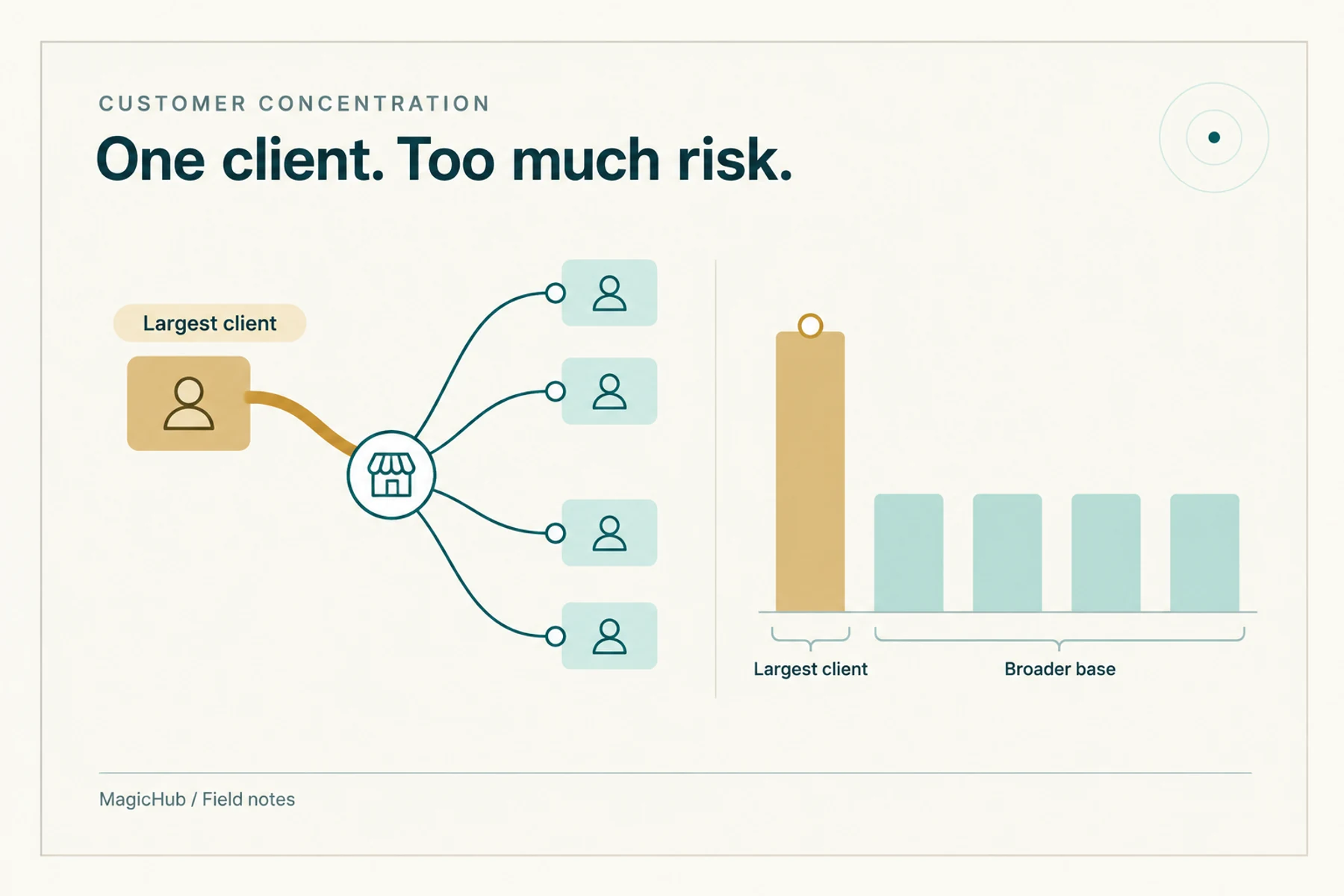
A large client has just renewed. The team can plan its workload, the sales forecast looks healthier and the relationship feels secure. It is also worth asking how much of the business now depends on that single decision-maker.
Customer concentration risk is the exposure created when a large share of your revenue comes from one customer or a small group. For an Australian small business, a useful review goes beyond the percentage. It connects the customer to the contribution they generate, the cash they owe and the commitments you would still need to pay if the relationship changed.
You do not need to turn down good work to take this seriously. You need to know what a disruption would do, how much time you would have to respond and which choices are available before pressure arrives.
Calculate concentration on a consistent basis
Start with sales by customer for the last twelve completed months. Use a consistent revenue basis, such as sales excluding GST, and reconcile the total to your accounting reports. Keep deposits, bank transfers and loan receipts out of a revenue calculation.
Largest-customer concentration = revenue from your largest customer ÷ total revenue × 100.
If one customer generated A$360,000 of A$1.2 million in annual revenue, its share is 30%. Repeat the calculation for the top three and top five customers. Compare the result with the preceding period, and review the forward order book separately so a recently won contract does not disappear inside a historical average.
Keep the original legal customer records intact, but add an analytical grouping for customers under common ownership or exposed to the same buying decision. Three billing accounts may provide little diversification if one head office can cancel all three contracts.
Revenue share is a starting signal, not a universal pass-or-fail score. A cancellable monthly arrangement, a seasonal order and a longer contract with minimum commitments have different risk profiles. Review the actual terms with your adviser rather than assuming that a familiar customer or a signed agreement guarantees future cash.
Look at contribution and receivables as well as sales
Build a short profile for each material customer:
- Revenue: annual share, recent trend and expected work over the next quarter.
- Contribution: revenue less the costs you can reasonably associate with delivering that work. State exactly which costs you include.
- Unpaid invoices: outstanding amount, overdue portion, disputes and expected collection dates.
- Committed capacity: staff, equipment, stock or suppliers arranged specifically for the account.
- Commercial terms: renewal and notice dates, payment terms, minimum volumes and any relevant conditions.
- Relationship ownership: your account owner, the customer's decision-makers and the next substantive review.
These measures answer different questions. A customer with a modest sales share can dominate unpaid invoices. A high-revenue contract can leave little contribution after delivery costs. A smaller, high-contribution account can be harder to replace than its sales ranking suggests.
Business Queensland's financial-risk guidance distinguishes customer credit risk from liquidity risk and recommends monitoring payments, establishing clear terms and forecasting situations that could affect cash flow. Your customer profile brings those checks together around the accounts that matter most.
Separate a late payment from a lost customer
Both can reduce the bank balance, but they require different model changes. A payment delay moves an expected receipt. A lost contract changes future work, invoicing and potentially delivery costs. Build each scenario explicitly using your existing scenario-planning process.
Scenario 1: an existing invoice is paid two weeks late
Fictional cash example: an Australian service business starts week one with A$40,000. Its base forecast closes the next four weeks at A$42,000, A$38,000, A$44,000 and A$50,000. Those balances already include a A$24,000 customer receipt in week two and all other forecast receipts and payments.
| Week | Base closing cash | Delayed-payment closing cash |
|---|---|---|
| 1 | A$42,000 | A$42,000 |
| 2 | A$38,000 | A$14,000 |
| 3 | A$44,000 | A$20,000 |
| 4 | A$50,000 | A$50,000 |
The month ends in the same place, but the lowest weekly closing balance falls from A$38,000 to A$14,000. If the business's own minimum operating buffer is A$20,000, week two is A$6,000 below that buffer. The buffer is an illustrative management choice, not an industry benchmark.
Move the receipt once: remove it from week two and add it to week four. Do not add the later collection while leaving the original receipt in place. This simplified example assumes every other cash flow stays unchanged and excludes any additional financing costs. Check daily timing around material payments because weekly closing balances can still hide a mid-week shortfall.
Use your 13-week cash flow forecast to test the full period, and connect uncertain invoices to a named collection action.
Scenario 2: the customer stops placing new orders
Now change the operating assumptions. Suppose the account normally contributes A$36,000 of monthly revenue and A$14,400 of genuinely avoidable delivery costs, both excluding GST. Losing the work removes A$21,600 of monthly contribution before fixed overheads.
That does not mean the bank balance falls by exactly A$21,600 that month. Old invoices may still be collected. Supplier bills for work already delivered may still need payment. Wages, leases and contractual commitments may continue after new orders stop.
Build the lost-customer case in this order:
- Set the date when new orders or deliveries stop, based on the scenario being tested.
- Remove the related future revenue and invoice schedule.
- Keep existing receivables unless you are separately testing non-payment.
- Reduce costs only from the dates they can actually stop, allowing for commitments and notice periods.
- Add any realistic transition costs, then model replacement sales with their own delivery and collection dates.
For an Australian forecast, keep the treatment of GST and other statutory payments consistent with the rest of the model. Ask your accountant to check the effect where needed. Do not assume an accounting expense reduction immediately becomes a cash saving.
Choose actions that change the exposure
Australian credit insurer Atradius highlights that dependence on major accounts can amplify payment and cash-flow vulnerability. Its discussion also points to changes in payment behaviour and key relationships as warning signs worth investigating. A single signal is a reason to ask questions, not proof that a customer is in trouble.
Turn your review into specific actions rather than a general instruction to diversify:
- Strengthen account visibility. Arrange a commercial review before a material renewal, confirm expected work and broaden legitimate working relationships beyond one contact.
- Improve future payment arrangements. Where commercially suitable, discuss deposits, progress billing or clearer acceptance milestones for new work. Record agreed changes; do not assume existing terms can be changed unilaterally.
- Reduce replacement time. Develop a realistic pipeline across different customers and buying cycles. Include the time and cash needed to win and deliver that work.
- Review dedicated commitments. Understand how long customer-specific capacity would remain a cost if demand stopped. Check obligations before proposing changes.
- Set a response trigger. For example, review discretionary spending when forecast cash falls below the business's chosen buffer, or escalate a material invoice when its promised payment date is missed.
Give every action an owner, a due date and an expected effect on the forecast. Recheck concentration at each monthly review and whenever a major contract is won, renewed or materially changed.
The useful outcome is a clear sentence: “This customer supports this much contribution, owes this much cash, and a disruption would put pressure on us in this week.” That is a stronger basis for growth decisions than either avoiding large customers altogether or assuming a good relationship removes the risk.
When evaluating MagicHub or another planning tool, ask to see how your actual customer assumptions and payment dates can be represented in the current product. Verify the workflow before relying on it; a dashboard alone does not establish that the underlying exposure has been modelled.
Sources checked 9 October 2026. General business education only, not accounting, tax, legal or financial advice. All worked examples are fictional and are not customer results or industry benchmarks.
Good thinking deserves
a connected workspace.
Bring your plans, numbers and customer workflows together.
Start free with MagicHub