
Break-Even Analysis: Can Your Business Afford a Discount?
A 10% discount can require far more than 10% extra sales. Use a worked Australian example to test contribution, capacity and cash before changing your price.

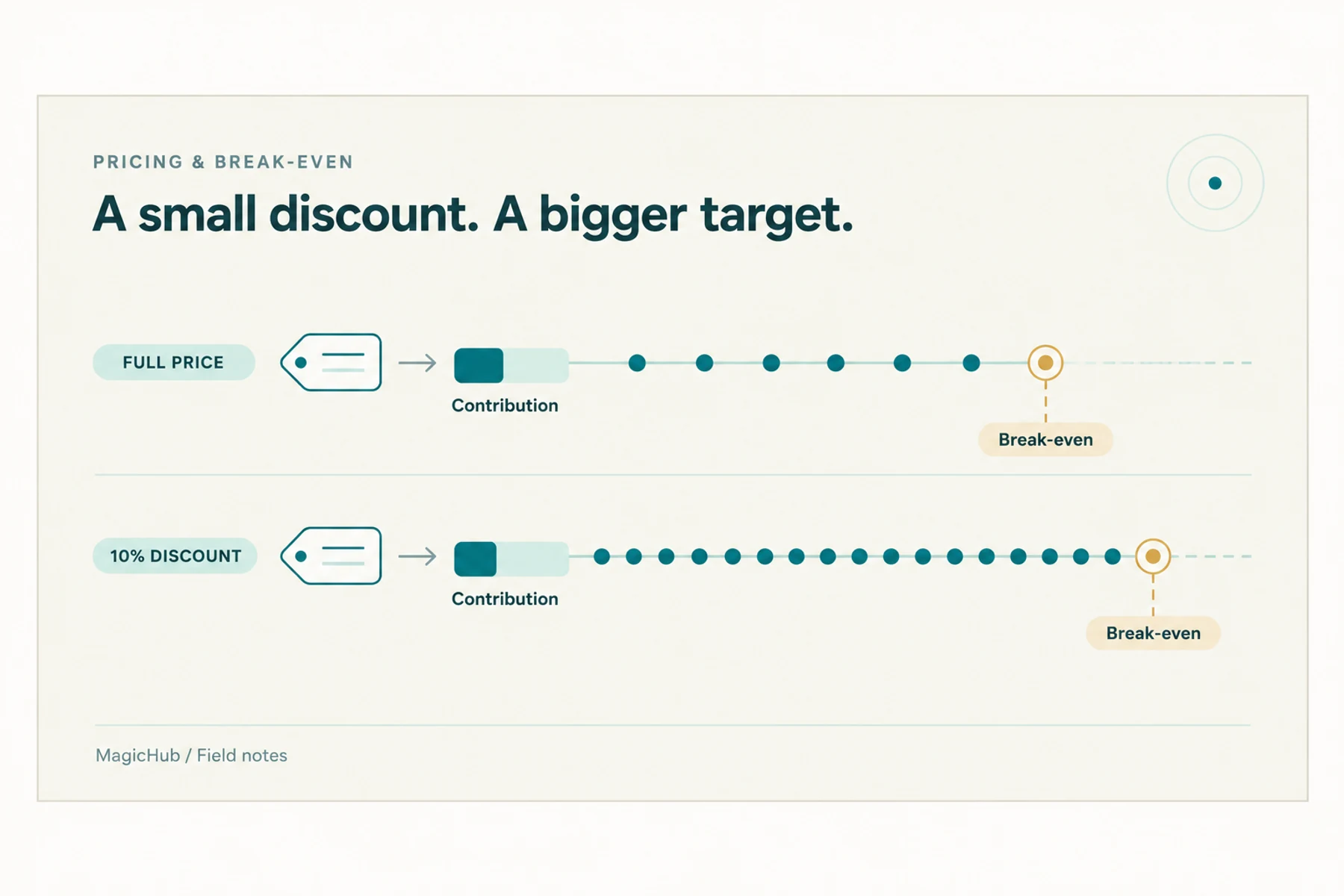
A 10 per cent discount sounds modest. But if each sale has to cover delivery costs before it contributes to rent, salaries and other overheads, the extra work needed to replace that discount can be surprisingly large.
A break-even analysis shows the sales needed to cover a defined set of costs. For an established small business, its most useful application is often a decision: can we afford this discount, absorb a supplier increase or take on more work at the current price?
In its 30 July 2026 Australian Small Business Insights release, Xero reported June-quarter sales growth of 6.5 per cent year-on-year, down from 7.9 per cent in the March quarter. That is sales growth, not a measure of profit or search demand. It is a useful reminder to test what additional revenue actually leaves behind.
Start with the contribution from one sale
For this analysis, contribution is the selling price less the costs that vary with the sale. The amount left contributes towards fixed costs and, once those are covered, profit.
The basic calculations are:
- Contribution per job = price per job − variable cost per job.
- Break-even jobs = fixed costs for the period ÷ contribution per job.
- Contribution margin ratio = contribution ÷ revenue.
- Break-even revenue = fixed costs ÷ contribution margin ratio.
Business Queensland's break-even guide provides a public calculator and explains the link between sales, costs and profit. For a management model, check the cost classifications: an accounting gross margin is not automatically the same as contribution margin if cost of sales includes fixed costs.
A worked example: what a 10 per cent discount really changes
Fictional example, not customer data or an industry benchmark. An Australian service business sells a repeatable project for A$2,000. Each project incurs A$800 of genuinely variable delivery costs. Monthly fixed operating costs are A$36,000. Amounts exclude GST to isolate the operating economics; income tax, financing and cash timing are outside this example.
At the normal price, each project contributes A$1,200. The business therefore needs 30 projects to cover A$36,000 of fixed costs. At 40 projects it generates A$80,000 of revenue and A$12,000 of operating profit under these assumptions.
Now reduce the price by 10 per cent to A$1,800, leaving variable costs unchanged. Contribution falls to A$1,000 per project, a 16.7 per cent reduction. The business needs 36 projects just to break even.
| Measure | Normal price | 10% discount |
|---|---|---|
| Price per project | 2,000 | 1,800 |
| Variable cost per project | 800 | 800 |
| Contribution per project | 1,200 | 1,000 |
| Projects to break even | 30 | 36 |
| Operating profit at 40 projects | 12,000 | 4,000 |
| Projects needed for A$12,000 profit | 40 | 48 |
To preserve the original A$12,000 profit, the discounted offer requires 48 projects: (A$36,000 + A$12,000) ÷ A$1,000. That is 20 per cent more work than the original 40 projects. The discount has not failed automatically; it has created a specific sales and capacity requirement.
Ask whether eight additional projects are realistically available, whether the team can deliver them and whether their timing creates a funding gap. An offer that fills otherwise idle capacity can behave differently from one that requires overtime, extra contractors or another employee.
Classify costs for the decision you are making
Do not label every expense simply by its ledger account name. A salaried delivery employee may be a fixed monthly commitment within current capacity, while an external specialist paid per project may be variable. If the next project requires another full-time role, costs increase in a step rather than a smooth percentage.
Write down the period, capacity range and inclusions beside the calculation. Split mixed costs where material. Include a realistic cost for the owner's work when judging commercial viability, while keeping drawings and distributions separate from accounting operating expenses. Avoid counting the same labour in both fixed overheads and variable delivery costs.
For multiple services, calculate contribution by service and use a realistic sales mix. A blended ratio based on last year's mix becomes unreliable if growth comes mainly from a lower-contribution offer.
Test price, scope and volume separately
A useful pricing review compares more than “discount” versus “no discount”. Alternatives might include a smaller scope, a minimum order, an optional service tier or a different delivery method. Each changes the customer proposition as well as the arithmetic.
business.gov.au's pricing guidance distinguishes approaches based on cost, competition and customer value. A cost calculation establishes what an offer must contribute under your assumptions; it does not prove what customers will pay.
Keep a base case and change one driver at a time. Our scenario-planning guide explains how to keep assumptions and their consequences connected. For the example above, test fewer sales, higher delivery costs and the point at which extra staffing becomes necessary before approving the offer.
Passing break-even does not mean the bank can fund it
A project can contribute positively while its delivery payments fall due before the customer pays. More discounted work can increase the amount tied up in unfinished work or receivables.
After testing profit, place the expected receipts and payments in a 13-week cash forecast. Include the actual GST and other obligations applicable to your business there. Keep the profitability model's assumptions distinct from the cash schedule rather than treating operating profit as available bank cash.
Bring five answers to the next pricing meeting
- What is the contribution at the proposed price and scope?
- How many additional sales are needed to preserve the desired profit?
- Can the team deliver that volume without a new cost step?
- When will delivery costs be paid and customer money collected?
- Who owns the result, and when will actual price, volume and delivery cost be reviewed?
Record the approved assumptions in the monthly business review. If the promised volume does not arrive, revisit the decision rather than quietly moving the target.
Explore MagicHub for our approach to connecting operating decisions with financial planning. Start with one offer and the question it needs to answer, then build the model around that decision.
General business education only, not accounting, tax, legal or financial advice. Examples are fictional and simplified. Have your accountant check cost classifications and the treatment appropriate to your business. Sources checked 14 October 2026.
Good thinking deserves
a connected workspace.
Bring your plans, numbers and customer workflows together.
Start free with MagicHub